
| Format | One unit | Pack and moisture | Where your brand goes | Units per kg of product* |
|---|---|---|---|---|
| Effervescent tablet in a tube | Tablet of 4 g; 20 to a tube, 80 g | Plastic tube with a desiccant cap, because the formula reacts with moisture | The tube, printed by the factory | 250 |
| Powder sachet | 4–12 g, set by the bulk density of the blend | Three-layer laminate: paper outside, aluminium foil as the barrier, sealable film inside | Printed straight on the paper layer; no separate label | 83–250 |
| Powder in a bag or jar | Serving of 30 g; fills of 450, 900 and 1,800 g | Zip-lock bag (450 g) or jar with a scoop (900 and 1,800 g) | Label artwork prepared with you and approved before printing | about 33 servings of 30 g |
| Hard capsule (market reference) | One shell sized to its fill | Sits inside an outer pack, which then carries the moisture protection | The outer pack | Counted per capsule; the grams of fill follow the bulk density of the blend |
*Calculated as 1,000 g divided by the unit mass. Product only, packaging not included. Your formula sets the final figures.
Effervescent tablet or capsule: how much fits in one unit?
A 4 g FIZZPHARMA effervescent tablet carries a serving that would take several large capsules. A capsule's fill in grams is the volume of its shell multiplied by the bulk density of the blend. So the exact count depends on your formula and on the shell you choose.
The real figure moves with your blend: the same shell holds fewer grams of a lower-density powder. FIZZPHARMA's standard tablet weighs 4 g. It suits a formula whose mass per unit is counted in grams. The capsule suits a fill that fits the shell. The comparison is about the mass of a unit, not its content of any one ingredient.
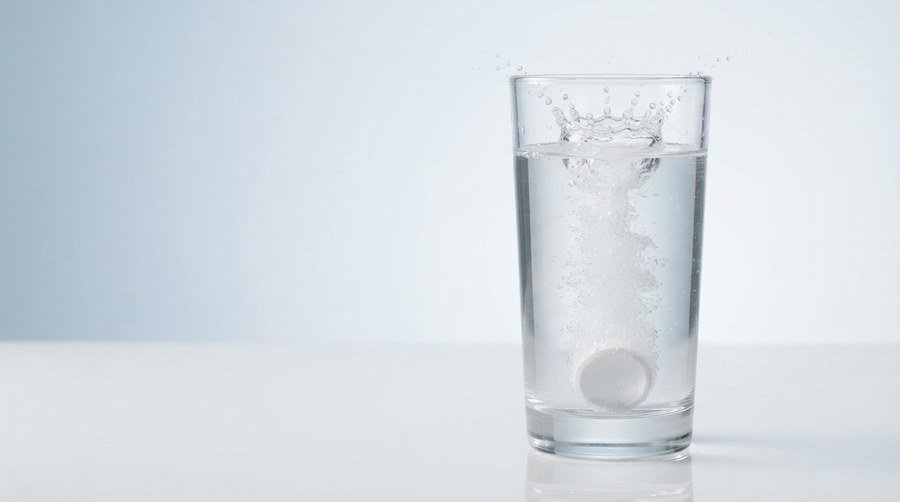
The price of the tablet is the pack. Its acid and bicarbonate react as soon as water reaches them, from a glass or from damp air. So it goes only into a closed tube.
Effervescent tablet or powder: what changes in packing and moisture?
The tablet needs a closed tube with a desiccant cap. A powder can take a sachet, a zip-lock bag or a jar. FIZZPHARMA's sachet carries an aluminium foil layer between the paper and the sealable film. The brand is printed on the paper, so the sachet is its own label.
Choose the powder pack by how the dose is taken:
- One dose sealed alone: the sachet, 4–12 g. It suits a dose that needs no scoop, travels in a bag or is sold as a course. Its price is a higher cost per serving than a jar.
- A dose scooped from a larger pack: the zip-lock bag or jar, from 300 kg of finished blend. Its price is the scoop and the larger pack.
- A dose above 12 g: the doy-pack (stand-up zip-lock bag), which moves out of the sachet range.
The tablet and the sachet therefore answer different questions. The tube protects a reactive tablet, and the foil layer protects a single powder dose. More on the tube and its cap is on effervescent tube packaging.
Tablet, capsule or powder: what changes for weight in the parcel?
By product weight alone, the mass of a unit fixes the count per kilogram. That is 250 tablets, 83–250 sachets or about 33 servings of a 30 g scoop. A capsule is counted by its fill, which follows the density of the blend. These are calculations on product only.
A tube of 20 tablets carries 80 g of product. A sachet at the top of the range carries 12 g. A 450 g bag holds 15 servings of 30 g. Count your servings per order from these masses before you compare freight. Delivery is worldwide, EXW by default, with FCA or DAP on agreement.
What sets the minimum order and the lead time for each format?
The minimum follows the format. For tablets it is low and counted in tubes. For sachets and for powders in bags or jars it is 300 kg of finished blend. Production of tablets and sachets takes from 4 weeks. Nothing is produced before you approve the sample and the label.
| FIZZPHARMA format | Minimum | What the minimum gives | Production | Shelf life |
|---|---|---|---|---|
| Effervescent tablet in a tube | Low, counted in tubes | The number of tubes is confirmed for your formula | From 4 weeks | 24 months standard |
| Powder sachet | 300 kg of finished blend | 25,000–75,000 sachets (12 g down to 4 g), before filling losses | From 4 weeks | 24 months standard |
| Powder in a bag or jar | 300 kg of finished blend | Counted in kilograms; servings follow from the 30 g scoop | Confirmed for your formula | 24 months standard |
Freight and customs come on top of production time. A repeat order carries the same minimum as the first. The full picture is on minimum order and lead time. The tablet is described in effervescent tablets in tubes.
How long does each format keep?
The standard shelf life at FIZZPHARMA is 24 months for tablets, sachets and powders alike. The least stable ingredient in the formula sets it, and the certificate of analysis (CoA) of each batch confirms it. It is a standard, agreed for your formula.
For a tablet the tube is part of that answer. The desiccant cap keeps the moisture that gets in away from the tablets. For a sachet the foil layer does the same job. Dispatch, transit and customs use up part of the 24 months before the goods reach a shelf. So plan the run backwards from the sale date.
Which format suits a new supplement brand?
Match your constraint to the format. A small first run with a serving size measured in grams points to the tablet. One measured portion points to the sachet. A scooped daily serving points to the bag or jar. The situation removes choices before taste does:
- Your formula is counted in grams per unit and you want a small first run. Choose the effervescent tablet in a tube: low minimum, from 4 weeks. Its cost is the tube and the discipline around moisture.
- Your dose is one measured powder portion for travel or a course. Choose the sachet: 4–12 g, from 300 kg. Its cost is a higher cost per serving than a jar.
- Your customer scoops a daily serving at home. Choose the bag or jar: 450, 900 or 1,800 g, from 300 kg. Its cost is the scoop and the larger pack.
- Your fill fits a standard capsule shell. The capsule is the reference to compare against. Its cost, set out above, is the count of shells once the fill is measured in grams.
The formats themselves are compared column by column in the effervescent formats hub.
Do the labelling rules change with the format?
What the label must say follows the composition, not the shape. In the EU a tablet, a capsule or a powder sachet can each be a food supplement under Directive 2002/46/EC. Any health claim on the pack needs authorisation under Regulation (EC) 1924/2006. Confirm the category for your formula with your legal adviser.
The sorbitol base of the effervescent tablet may add one rule. Regulation (EU) 1169/2011, Annex III, point 2.4, requires a laxative-effect warning on a food with more than 10% added polyols. Whether it applies depends on the polyol share in your tablet. FIZZPHARMA prepares the label artwork with you, and you approve it before printing. Your importer confirms the rules of the country of sale.
FAQ
Can a new supplement brand launch with effervescent tablets?
Yes. FIZZPHARMA makes effervescent tablets of 4 g, 20 to a tube, under your brand. The minimum is low, counted in tubes, and production takes from 4 weeks. You can start with a catalogue formula or have a formula developed for your brand. The plant's list holds more than 500 ready-made formulas in production across its formats, with new ones added every month.
How does a 4 g effervescent tablet compare with capsules?
A 4 g FIZZPHARMA tablet carries a serving that would take several large capsules. The exact count depends on the bulk density of your blend and the shell size. A tube of 20 tablets carries 80 g of product, and the tablet reaches the consumer from a closed tube with a desiccant cap.
Why are effervescent tablets packed in a tube and not a bottle or pouch?
The acid and bicarbonate in the tablet react with moisture, including damp air. FIZZPHARMA chooses a plastic tube whose cap holds a desiccant, so that the tablets stay dry. If you want another pack, send it with your brief and the reply discusses it. The factory prints your brand on the tube.
What is the entry order for a tablet and for a sachet?
The entry points differ in kind. A tablet has a low minimum counted in tubes, with the figure given in FIZZPHARMA's reply. A sachet starts from 300 kg of finished blend, which is 25,000–75,000 sachets, from 12 g down to 4 g. Prices are given in the reply once formula and pack are fixed.
How long does production take for tablets, sachets and powders?
Production at FIZZPHARMA takes from 4 weeks for effervescent tablets and for powder sachets, using a catalogue formula or your own formula. For powders in a bag or jar the time is given in the reply to your enquiry. Freight and customs are added. Nothing is produced before the sample and the label are approved.
What shelf life can I print on the pack?
The standard at FIZZPHARMA is 24 months for tablets, sachets and powders, set by the least stable ingredient and confirmed in the CoA of each batch. Plan the run so the goods reach the shelf with time to spare.
Do the three formats follow different labelling rules?
The same Directive covers all three forms. What the label must say follows the composition. A tablet, a capsule or a sachet of powder can each be a food supplement under Directive 2002/46/EC. Health claims need authorisation under Regulation 1924/2006. FIZZPHARMA prepares the artwork with you. Your importer confirms the rules of the country of sale.
Who prints the tube, the sachet and the bag?
FIZZPHARMA prints them at the factory. The label artwork is prepared with you, or you bring your own, and only the approved version goes to print. A pack of your own for a sachet or a bag is accepted on request: send its specification with the enquiry.
Where to go next
Compare every FIZZPHARMA format on the effervescent formats hub. Read the format pages for effervescent tablets in tubes and powder sachets. Check minimum order and lead time. Send the format you have in mind through the contact page. FIZZPHARMA replies within 24 hours, Monday to Friday.
Sources
- Directive 2002/46/EC on food supplements: https://eur-lex.europa.eu/legal-content/EN/TXT/HTML/?uri=CELEX:32002L0046
- Regulation (EU) 1169/2011 on food information to consumers, Annex III, point 2.4 (polyols): https://eur-lex.europa.eu/legal-content/EN/TXT/HTML/?uri=CELEX:32011R1169
- Regulation (EC) 1924/2006 on nutrition and health claims: https://eur-lex.europa.eu/legal-content/EN/TXT/HTML/?uri=CELEX:32006R1924