
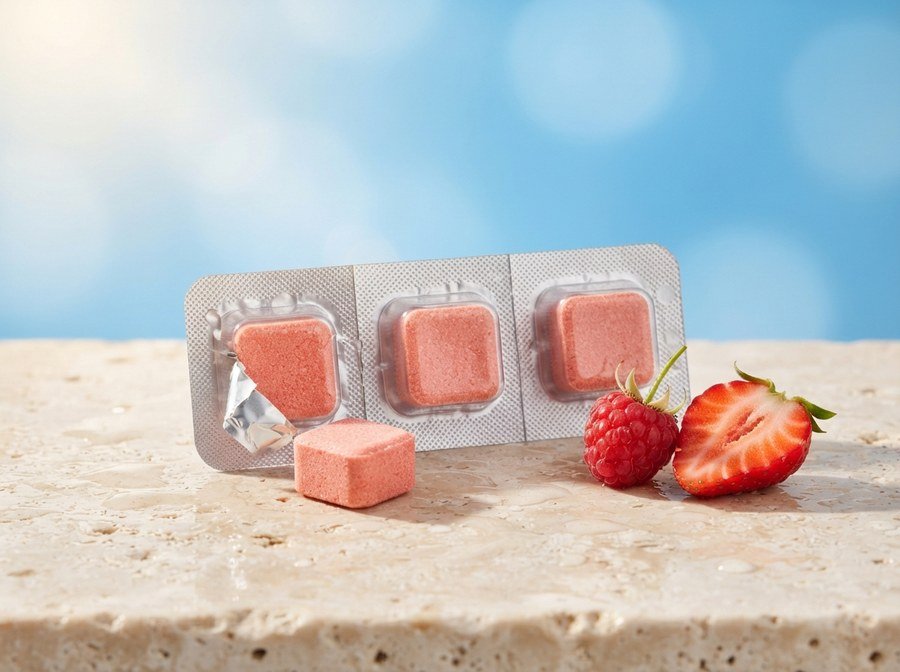
FIZZPHARMA is a contract manufacturer in the European Union. It makes effervescent tablets in tubes, drink cubes each sealed in its own blister, and powder sachets under your brand. Every weight below carries its source, and each pack's trade-off is named, so you can check the comparison yourself.
Key takeaways
- A cube in a retailer listing weighs 2 g; a bottled 500 ml serving is about 500 g of water. That is 250 to 1.
- Twelve servings weigh 24 g as cubes, 48 g as 4 g tablets, 48–144 g as 4–12 g sachets, about 154 g as electrolyte sticks and about 6,000 g as bottles.
- One tonne of freight carries 500,000 cubes of 2 g, or 2,000 bottled servings of water alone.
- The cube listing asks for a cool, dry place away from light. Keeping moisture out is the main job of an effervescent pack.
- Tubes and sachets carry a standard shelf life of 24 months, confirmed on the certificate of analysis; the least stable ingredient sets the final figure.
How much does one serving weigh in cube, tablet, sachet, stick and bottle form?
One serving weighs 2 g as a cube in a retailer listing, 4 g as a FIZZPHARMA effervescent tablet, 4–12 g as a FIZZPHARMA powder sachet, about 12.8 g as a warehouse-club electrolyte stick and about 500 g as a bottled drink. Twelve servings run from 24 g to about 6 kg.
| Format | Mass per serving | Twelve servings | Source |
|---|---|---|---|
| Drink cube in a retailer listing | 2 g; one cube per 400–600 ml of water | 24 g | Retailer listing, October 2026 |
| FIZZPHARMA effervescent tablet | 4 g; 20 per tube, 80 g of tablets | 48 g | FIZZPHARMA specification, tube and cap excluded |
| FIZZPHARMA powder sachet | 4–12 g of fill | 48–144 g | FIZZPHARMA specification |
| Warehouse-club own-brand electrolyte stick | About 12.8 g (0.45 oz) | About 154 g | Club's business-site listing, October 2026, converted |
| Bottled drink, 500 ml | About 500 g of water, bottle excluded | About 6,000 g | Arithmetic at 1 g per ml |
| FIZZPHARMA drink cube | 12 × the cube weight | Set with the formula |
The tablet and sachet rows count one unit per serving; the formula sets the real number. A stick weighs 6.4 times a cube, so a box of 40 sticks is about 510 g against about 80 g for 40 cubes.
Why does weight decide shipping cost for an online drinks brand?
Parcels and pallets are priced by weight and volume, so a brand that ships water pays to move water. The brand behind that listing was reported in May 2026 to earn about 70% of sales online. Its founder said in January 2020 that 80% of sales were then through e-commerce, and described a 12-cube pack as having less packaging than the cap of a normal bottle.
The weight of a serving is fixed when you choose the format, long before the first parcel is booked.
How many servings fit in a parcel or on a pallet?
By mass alone, one tonne carries 500,000 cubes of 2 g, 250,000 tablets of 4 g or 2,000 bottled servings of 500 ml, with packaging ignored. A pallet is limited by pack volume as well as mass, so tube, cube box and sachet carton dimensions set the real count.
A smaller example: 100 boxes of 12 cubes weigh 2.4 kg for 1,200 servings; the same 1,200 bottled servings hold about 600 kg of water.
Do cubes, tubes and sachets need a cold chain, and how long do they keep?
The retailer listing for a drink cube asks for a cool, dry place away from light and does not mention refrigeration. For effervescent formats the pack's main job is keeping moisture out. FIZZPHARMA puts tablets in a tube with a desiccant cap, seals each cube in its own blister and fills sachets in a laminate of paper, aluminium foil and sealable film.
Tubes and sachets carry a standard shelf life of 24 months, confirmed on the certificate of analysis for each batch. The least stable ingredient in the formula sets the final figure. For cubes,; none of the store listings reviewed states a number. Ask for the storage conditions of your formula before you plan the warehouse.
Which pack protects better in a hot, humid warehouse: tube, blister or sachet?
No pack wins on every route, because each trades protection against cost and handling. A tube with a desiccant cap suits many servings opened over weeks, a blister seals every cube until the moment it is used, and an aluminium-foil sachet seals one dose. For a hot, humid route, ask for stability data at your destination's temperature and humidity.
| Pack | How it keeps moisture out | Best for | Trade-off |
|---|---|---|---|
| Tube with desiccant cap | Closed tube; the cap absorbs moisture | Many servings used over time | Every opening lets room air in |
| Blister per cube | Each cube sealed under its own foil lid until used | One serving per sale, a visible product | More pack material per serving than a tube |
| Sachet | Laminate of paper, aluminium foil and sealable film, one dose each | Exact doses on the move | Costs more per serving than a jar or tub |
How much brand space does each format offer?
FIZZPHARMA prints your brand on the tube, on the foil lid of each cube blister and its carton, and directly on the paper layer of a sachet, with no separate label. Small packs also carry mandatory text: Regulation (EU) 1169/2011 sets a minimum x-height of 1.2 mm, or 0.9 mm where the largest face is under 80 cm².
Below 10 cm², Article 16(2) allows only a short list of particulars to be required on the pack itself. A blister foil is small, so plan its design around the mandatory text from the start.
What is the real cost per serving from factory to customer?
Cost per serving is the unit price plus inbound freight, warehouse space, outbound parcel and returns, and weight and volume drive most of the last three. FIZZPHARMA quotes price per product on request. Shelf prices show the range: a drink cube brand launched in the US at US$11 for 12 cubes (about US$0.92 each, 2021), while a German discounter's own-brand effervescent tablet cost €0.55 for 17 (about €0.03, Öko-Test, 2015).
The years, currencies and products differ, so read the gap as an order of magnitude. It suggests where an own-label brand has room to set its price.
What this means for your brand
Treat weight per serving as a product decision:
- Selling online: design around the parcel. A cube, tablet or sachet turns a freight bill for water into one for a few grams.
- Selling through retail: shelf life and carton size come first. Ask for the shelf-life figure and the carton dimensions before you order.
- Shipping a long, hot or humid route: test the pack on your own lot.
FIZZPHARMA makes all three dry formats under your brand and ships each batch with a certificate of analysis and a specification. Send the serving size, the sales channel and the route, and you get a reply within 24 hours, Monday to Friday.
FAQ
How much does a drink cube weigh?
A retailer listing for a drink cube brand shows 24 g for 12 cubes, or 2 g per cube, made for 400–600 ml of water. The weight of a FIZZPHARMA drink cube is set with the formula, and the figure is confirmed in FIZZPHARMA's reply to your enquiry.
How much heavier is a bottled drink than a cube?
A 500 ml bottled serving holds about 500 g of water, bottle excluded, against 2 g for a cube in a retailer listing. That is roughly 250 times the mass: twelve bottled servings hold about 6 kg of water, twelve cubes weigh 24 g.
Do drink cubes need refrigeration?
The retailer listing for a drink cube asks for a cool, dry place away from light and does not mention a refrigerator. Dryness is the main requirement for effervescent formats, and FIZZPHARMA seals each cube in its own blister.
How long do effervescent tablets and sachets last in storage?
FIZZPHARMA gives a standard shelf life of 24 months for effervescent tablets in tubes and for powder sachets, confirmed on the certificate of analysis. The least stable ingredient in the formula sets the final figure for your product.
Can I print my brand on a drink cube blister?
Yes. FIZZPHARMA prints your brand on the foil lid of each blister and on the carton, to your design.
What is the minimum order for drink cubes?
FIZZPHARMA counts the minimum per product, in cubes and boxes, so three flavours are three products. A repeat order carries the same minimum as the first. Tablets in tubes and powder sachets are produced from 4 weeks, with transport and customs on top.
Sources
- Pictet, interview on the micro-drink category, 30 January 2020, 80% of sales through e-commerce at the time, 12-cube pack with less packaging than a bottle cap: https://www.pictet.com/ae/en/insights/how-a-new-micro-drink-is-disrupting-the-usd-600bn-beverage-industry
- EUR-Lex, Regulation (EU) 1169/2011, Articles 13 and 16: https://eur-lex.europa.eu/legal-content/EN/TXT/HTML/?uri=CELEX:32011R1169