
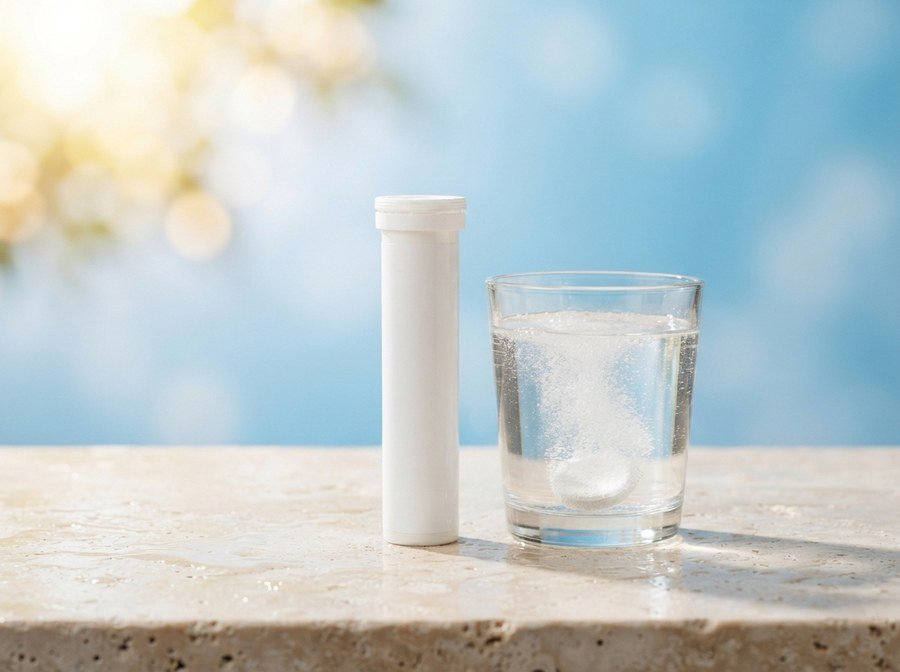
FIZZPHARMA makes private-label effervescent tablets in tubes, drink cubes in single blisters and powder sachets in the European Union. This checklist answers the category question, which comes before any artwork, from the text of the EU rules. It explains the law and is not legal advice: your importer or a regulatory adviser confirms the final wording for each market.
What makes an effervescent product a food supplement under Directive 2002/46/EC?
Article 2(a) of Directive 2002/46/EC defines food supplements as foods that supplement the normal diet and are concentrated sources of nutrients or other substances with a nutritional or physiological effect, sold in dose forms such as capsules, tablets or drop bottles. An effervescent tablet or cube that delivers vitamins or minerals in a daily dose fits that definition, and its pack must say so.
Shape does not decide the category. A pressed cube and a pressed tablet are made the same way, with acid and bicarbonate compressed together, so a cube can fall on either side. Content and presentation decide. That is the usual reading of the definition; settle it from the formula specification before artwork is drawn.
Article 6 then fixes what a supplement label carries: the name "food supplement"; the category of nutrients or substances; the recommended daily portion; a warning not to exceed it; a statement that supplements do not replace a varied diet; and a statement to keep them out of the reach of young children. Article 6 also bars any claim that the product prevents, treats or cures a disease.
Which rules apply to a flavoured drink cube with no added nutrients?
A cube that only flavours, colours or sweetens water is usually an ordinary food, so Regulation (EU) No 1169/2011 governs its label: the name of the food, the list of ingredients and the other particulars in Article 9(1). The nutrition declaration section is where the two categories split: Article 29 takes food supplements out of it.
Two cubes can look identical on a shelf and sit in different categories: the same cube with a vitamin dose follows the supplement route and takes its words from Article 6.
When can an effervescent product say "sugars-free"?
Under the Annex to Regulation (EC) No 1924/2006, "sugars-free" may be used only if the product contains no more than 0.5 g of sugars per 100 g or per 100 ml. Article 3 adds that no claim may be false, ambiguous or misleading, and Article 10(1) bans health claims that are not authorised.
| Wording | Condition in the Annex to Regulation 1924/2006 |
|---|---|
| Sugars-free | No more than 0.5 g of sugars per 100 g or per 100 ml |
| Low sugars | No more than 5 g per 100 g (solids) or 2.5 g per 100 ml (liquids) |
| No added sugars | No added mono- or disaccharides and no food used for its sweetening properties; with natural sugars present, the pack states "contains naturally occurring sugars" |
| Low energy | No more than 40 kcal per 100 g (solids) or 20 kcal per 100 ml (liquids) |
| Energy-free | No more than 4 kcal per 100 ml |
Treat each line as a gate: a formula that fails gains nothing by rewording. A cube is a solid that is drunk as a solution, so agree with your label reviewer whether the claim rests on 100 g of the product or on 100 ml of the drink, and keep the calculation in the product file.
Health claims are a separate gate. Wording about immunity, energy or performance counts as a health claim. Article 10(1) allows it only when the claim is authorised and listed under Articles 13 and 14, and Article 10(2) then requires information on the importance of a varied diet.
Wording that says a product prevents, treats or cures a disease is barred for supplements by Article 6 of Directive 2002/46/EC and for food in general by Article 7(3) of Regulation 1169/2011. Article 7(4) extends this to advertising and to how the pack is presented, so the artwork review reads the front panel and names too.
What is the smallest print size, and what changes on small packs?
Article 13(2) of Regulation 1169/2011 sets the minimum x-height at 1.2 mm. For a pack whose largest surface is under 80 cm², Article 13(3) lowers it to 0.9 mm. Under 10 cm², Article 16(2) requires only items (a), (c), (e) and (f) of Article 9(1) on the pack (the name of the food, allergens, net quantity and date of minimum durability), with the ingredient list given by other means.
The x-height is the height of a lowercase "x", not the point size, so have the designer measure it on the print-ready file. The 80 cm² and 10 cm² lines apply to the largest surface of the pack: an 8 × 9 cm face is 72 cm², a 10 × 10 cm face is 100 cm², a 4 × 2 cm face is 8 cm². A single-cube blister, a tube and a sachet each offer brand space on a small surface, and the legal text has to stay readable on it.
How must a table-top sweetener be named, and when is the polyol warning needed?
Article 23 of Regulation (EC) No 1333/2008 requires the sales description of a table-top sweetener to include the term "[sweetener]-based table-top sweetener". Annex III, point 2.4 of Regulation 1169/2011 adds a warning that excessive consumption may produce laxative effects for foods with more than 10% added polyols.
The definition turns on purpose, not shape: preparations of permitted sweeteners sold to the final consumer as a substitute for sugars. Regulation 1333/2008 carries its own polyol warning with slightly different wording ("induce" in place of "produce"), so check the text that matches your product.
Sorbitol is a polyol. For an effervescent tablet on a sorbitol base, the share of added polyols is read off the finished formula and tested against the 10% line. Name the base by composition ("on a sorbitol base") and let the claims table decide whether "sugars-free" can be used at all.
What is the labelling checklist for brand owners?
Run these seven checks in order, starting with the category: it decides which column applies.
| # | Check | Flavour-only cube (food) | Cube or tablet with nutrients (supplement) | Rule |
|---|---|---|---|---|
| 1 | Category | Flavour, colour, sweetener | Concentrated source of nutrients in dose form | Dir. 2002/46/EC, Art. 2(a) |
| 2 | Name and mandatory text | Name of the food; Art. 9(1) particulars incl. ingredients | "Food supplement" plus five Art. 6 statements | Reg. 1169/2011, Art. 9(1); Dir. 2002/46/EC, Art. 6 |
| 3 | Nutrition declaration | Falls under the nutrition declaration section; reviewer confirms any exemption | Taken out of that section | Reg. 1169/2011, Art. 29 |
| 4 | Print size | 1.2 mm; 0.9 mm under 80 cm²; short list under 10 cm² | Same | Reg. 1169/2011, Arts. 13, 16(2) |
| 5 | Sugar and energy claims | Annex thresholds only | Same | Reg. 1924/2006, Annex |
| 6 | Health and disease claims | Authorised claims only; no disease claims | Same | Reg. 1924/2006, Art. 10; Reg. 1169/2011, Art. 7 |
| 7 | Sweetener name and polyols | "…-based table-top sweetener"; warning above 10% added polyols | Same polyol test | Reg. 1333/2008, Art. 23; Reg. 1169/2011, Annex III |
Who checks the final label and who files the registration?
The brand owner approves the label layout, the importer confirms the rules of the country of sale, and the importer holds the product registration there. FIZZPHARMA prepares the label artwork with you and supplies the specification, the CoA and the site certificates the importer needs.
Nothing is produced until you approve the sample and then the label layout. FIZZPHARMA prints the tube, the foil, the carton or the sachet itself, and makes and inserts the leaflet in the language of your layout.
What this means for your brand
- Write the category on the formula specification before the designer opens a file. Name, statements and claims follow from it.
- Treat every claim as a gate. Run the threshold and keep the calculation.
- Design small packs from the print floor outward. Measure each face and put the brand weight on the foil, the tube wall or the sachet front.
- Name sweeteners under Article 23 and run the polyol arithmetic on the finished formula.
- Ask your importer in the first week for the rules of each country of sale and let the importer confirm them.
FIZZPHARMA is a contract manufacturer of effervescent forms under your label: tablets in tubes, cubes in single blisters and sachets. Send the formula brief and your draft artwork, or ask for a design. A reply comes within 24 hours, Monday to Friday.
FAQ
Is an effervescent drink cube a food or a food supplement in the EU?
It depends on the formula. A cube that only flavours or sweetens water is usually an ordinary food under Regulation (EU) No 1169/2011. A cube or tablet that delivers nutrients in a daily dose is a food supplement under Directive 2002/46/EC. Label artwork is prepared with you starting from that category.
What must a food supplement label carry under Directive 2002/46/EC?
Article 6 requires the name "food supplement", the category of nutrients or substances, the recommended daily portion, a warning not to exceed it, a statement that supplements do not replace a varied diet, and a statement to keep them out of the reach of young children.
When can an effervescent product say "sugars-free"?
Only when it contains no more than 0.5 g of sugars per 100 g or per 100 ml, the threshold in the Annex to Regulation (EC) No 1924/2006. "No added sugars" has its own conditions, including the phrase "contains naturally occurring sugars" where natural sugars are present.
What is the smallest text allowed on a small effervescent pack?
The minimum x-height is 1.2 mm, and 0.9 mm when the largest surface of the pack is under 80 cm² (Regulation 1169/2011, Articles 13(2) and 13(3)). Under 10 cm², Article 16(2) limits the mandatory pack text to items (a), (c), (e) and (f) of Article 9(1): the name of the food, allergens, net quantity and date of minimum durability.
How must a sweetener tablet or cube be named?
Under Article 23 of Regulation (EC) No 1333/2008 the sales description includes the term "[sweetener]-based table-top sweetener". Where added polyols exceed 10%, Annex III, point 2.4 of Regulation 1169/2011 adds the warning that excessive consumption may produce laxative effects.
Who files the product registration in the importing country?
Your importer files it in the country of sale, using the documents FIZZPHARMA supplies: the specification, the CoA for each batch and the site certificates. The importer also confirms the label rules of that country.
Sources
- EUR-Lex, Directive 2002/46/EC, Articles 2(a), 6: https://eur-lex.europa.eu/legal-content/EN/TXT/HTML/?uri=CELEX:32002L0046 (reviewed 18 October 2026)
- EUR-Lex, Regulation (EU) No 1169/2011, Articles 7, 9(1), 13, 16(2), 29, Annex III point 2.4: https://eur-lex.europa.eu/legal-content/EN/TXT/HTML/?uri=CELEX:32011R1169 (reviewed 18 October 2026)
- EUR-Lex, Regulation (EC) No 1924/2006, Articles 3, 10 and the Annex: https://eur-lex.europa.eu/legal-content/EN/TXT/HTML/?uri=CELEX:32006R1924 (reviewed 18 October 2026)
- EUR-Lex, Regulation (EC) No 1333/2008, Article 23: https://eur-lex.europa.eu/legal-content/EN/TXT/HTML/?uri=CELEX:32008R1333 (reviewed 18 October 2026)