
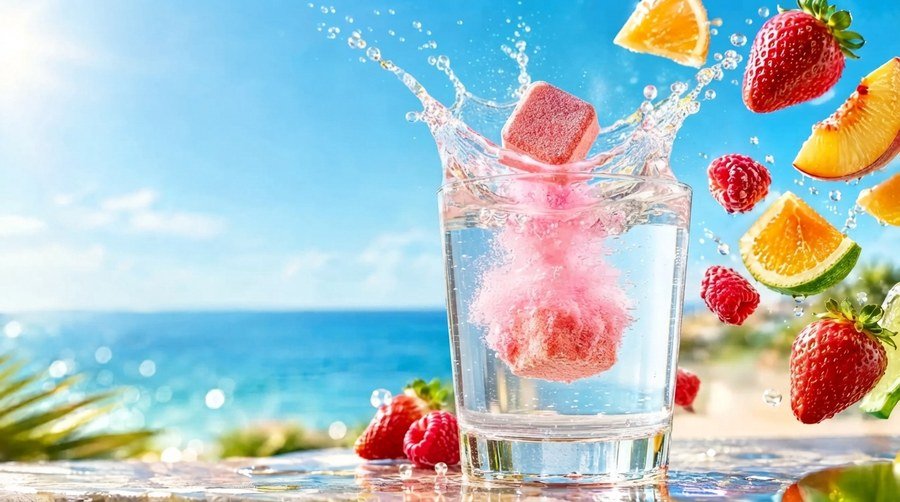
FIZZPHARMA makes effervescent tablets in tubes, drink cubes sealed one by one in blisters and powder sachets under other brands' labels, and the production group behind it counts the UAE, Saudi Arabia and Lebanon among its main markets. This guide covers what the tax counts, how heat decides the pack, and what an importer asks for.
Key takeaways
- The tax follows sugar per 100 ml of the drink as prepared, not the weight of powder in the pack.
- Under 5 g per 100 ml is zero in Saudi Arabia, so recipe sugar is now a cost line you can design.
- Heat and humidity decide the pack: effervescent formulas react with moisture, so tube, individual blister or laminate sachet are the formats built for a long route.
- Whether stevia counts as an "artificial sweetener" for the zero tier is an open question. Get a written ruling before you print.
- Ask for stability data at 30 °C and 65–75% relative humidity, and let your importer confirm the storage zone.
What changed in Saudi and UAE sugar taxes on 1 January 2026?
A GCC committee decision of 8 October 2025 set the sugar-based tiers, and the UAE adopted the same structure. It is part of a wider wave: WHO counted at least 116 countries taxing sugary drinks in January 2026. The Saudi tiers, with the tax on two common pack sizes worked out from the published per-litre rates:
| Sugar per 100 ml of ready drink | Rate | Tax on a 330 ml can | Tax on a 500 ml bottle |
|---|---|---|---|
| Only artificial sweeteners, or under 5 g | Zero | SAR 0 | SAR 0 |
| 5 to 7.99 g | SAR 0.79 per litre | SAR 0.26 | SAR 0.40 |
| 8 g or more | SAR 1.09 per litre | SAR 0.36 | SAR 0.55 |
Prices moved at once. In the UAE a 330 ml artificially sweetened cola dropped from about Dh 2.50 to Dh 1.65–1.70, while cheap sugary drinks rose 20–40% (Gulf News, 7 January 2026).
Are drinks made from powders, cubes or concentrates taxed on the prepared drink?
Yes, in Saudi Arabia and South Africa the tax is worked out on the drink as prepared by the pack instructions, not on the powder in the sachet. KPMG lists concentrates, powders, gels and extracts as covered. South Africa's Health Promotion Levy has done the same since 2018: 2.1 cents per gram of sugar above 4 g per 100 ml.
The UK goes the other way: powder sold as powder is excluded, while flavouring concentrates have been liable since 1 April 2023. For the UAE, ask your importer how powders are treated.
The cost for a cube or powder brand is that your dilution line becomes a tax variable. The volume printed on the pack sets the grams per 100 ml, so changing it later means changing the pack. Across Africa the rules differ by country, so your importer confirms them.
Which sweeteners put a drink in the zero tier, and where does stevia stand?
EY and KPMG both describe the zero tier as drinks sweetened only with artificial sweeteners. Whether steviol glycosides (stevia) fall inside that wording is an open question for the tax authority, not for a brand to assume.
The published tiers add a nuance. Anything under 5 g of sugar per 100 ml is at zero on sugar alone, so a stevia recipe with little sugar may land at zero either way. The open point is how the authority reads "sweetener-only" for stevia. Get that ruling in writing before the formula is fixed.
Search interest differs by market: the Arabic search term for stevia scores about 47 in Saudi Arabia and 53 in Egypt, against 4 in the UAE (Google Trends, five-year relative index, October 2026).
Why do effervescent products need moisture-proof packs in hot, humid ports and warehouses?
An effervescent formula reacts with moisture. That is why the standard pack for effervescent tablets is a plastic tube with a moisture-absorbing cap, not a bottle or a bag. Each extra week at a port or in an importer's warehouse adds exposure, and the pack carries the protection.
WHO's stability guidance (Technical Report Series 1010, Annex 10) sets long-term conditions for hot-and-humid markets at 30 °C and 65% relative humidity (zone IVa) and 30 °C and 75% (zone IVb). It was written for medicines, not food, so use it as a yardstick for a conversation with your manufacturer and importer. Which zone a country or route falls under is for the importer to confirm.
Tube, blister or sachet: which format suits a long route to a Gulf or African importer?
| Tube (effervescent tablets) | Individual blister (drink cubes) | Sachet (powders) | |
|---|---|---|---|
| Moisture barrier | Plastic tube, moisture-absorbing cap | Each cube sealed in its own blister with foil | Paper, aluminium foil and sealable film laminate |
| Serving unit | Standard tube: 20 tablets of 4 g | One cube per blister | 4–12 g dose |
| Where the brand goes | Printed on the tube at the plant | Blister foil and outer box | Directly on the paper layer |
| Minimum | Low minimum, counted in tubes | Per product, counted in cubes and boxes | From 300 kg of finished blend |
| Production time | From 4 weeks | From 4 weeks | |
| Cost to you | One pack only: the formula decides | Every serving carries its own seal | More per serving than a jar |
Production time is plant time; transport and customs come on top.
What storage and stability data should you ask a manufacturer for?
Four items belong in every hot-climate enquiry:
- Shelf life and what sets it. For effervescent tablets and sachets FIZZPHARMA's standard shelf life is 24 months under the storage conditions printed on the pack.
- The pack the data was measured in. Tube, blister or laminate, as shipped.
- Storage conditions on the label. They should match the zone your importer names.
- Results at 30 °C with 65–75% relative humidity for the pack you will ship.
What does the importer need from the manufacturer?
A certificate of analysis and a specification for each batch, plus copies of the site certificates (ISO 22000, GMP, HACCP). Your importer files the product registration with these documents. For legalised paperwork, Certificate of Free Sale, Certificate of Manufacture, apostille and consular legalisation are all available. Where a market asks for halal, the certificate is issued per batch of your product, either by a visiting certification body or with an auditor present at the production of the batch.
What should you decide before you brief a manufacturer?
Three decisions, in this order. Set the sugar target per 100 ml as prepared, because it fixes your tax tier and your dilution line. Choose the format for the route: tube, blister or laminate sachet. Then give your importer the documents above and ask for the stevia and storage rulings in writing.
FIZZPHARMA prints all packaging at the plant and works with buyers worldwide, including in Africa. Send the destination, the route, the format and the sugar target. The reply comes within 24 hours, Monday to Friday, with a pack recommendation for your formula.
Frequently asked questions
Is a drink made from a cube or powder taxed on the powder or the finished drink?
On the finished drink. Saudi Arabia counts powders, concentrates, gels and extracts as prepared according to the pack instructions, and South Africa does the same. The dilution printed on your FIZZPHARMA pack therefore sets the grams of sugar per 100 ml that decide your tier.
What sugar level puts a drink in the zero tier in Saudi Arabia?
Under 5 g of sugar per 100 ml of the ready drink, and drinks sweetened only with artificial sweeteners. From 5 g the rate is SAR 0.79 per litre, and from 8 g it is SAR 1.09 per litre. FIZZPHARMA develops a sample to your brief, so the sugar target goes into the brief first.
Does stevia count as an artificial sweetener for the Gulf zero tier?
The published wording is "artificial sweeteners", and whether stevia is inside it is an open question for the tax authority. A recipe under 5 g of sugar per 100 ml is at zero on sugar alone. Ask your importer for a written ruling before FIZZPHARMA fixes the formula.
Which pack survives a hot, humid route?
For effervescent tablets, a plastic tube with a moisture-absorbing cap, because the formula reacts with moisture. For cubes, an individual sealed blister. For powders, a paper, foil and film laminate sachet. FIZZPHARMA matches the format to your route.
How long does a first shipment take?
Production of effervescent tablets and sachets at FIZZPHARMA starts from 4 weeks, with transport and customs on top. Cube lead time is confirmed in the reply to your enquiry. Delivery is EXW by default, with FCA or DAP on request.
Does FIZZPHARMA offer halal certification for Gulf markets?
Yes, where your market needs it. The certificate is issued per batch of your product, not for the plant. Either a certification company visits, or an auditor attends the production of the batch. Name the market in your enquiry.
Sources
- WHO, news release on sugary-drink taxes, 13 January 2026: https://who.int/news/item/13-01-2026-cheaper-drinks-will-see-a-rise-in-noncommunicable-diseases-and-injuries (reviewed 2026-10-18)
- EY Global Tax News, Saudi sweetened-beverage tiers, 3 December 2025: https://globaltaxnews.ey.com/news/2025-2415 (reviewed 2026-10-18)
- KPMG Saudi Arabia, excise tax amendments for sweetened beverages: https://kpmg.com/sa/en/insights/tax-insights/amendments-to-the-excise-tax-implementing-regulations-primarily-impact-sweetened-beverages.html (reviewed 2026-10-18)
- Gulf News, UAE sugar tax and drink prices, 7 January 2026: https://gulfnews.com/business/retail/uaes-new-sugar-tax-is-already-changing-what-residents-pay-for-drinks-1.500400390 (reviewed 2026-10-18)
- South African Revenue Service, Health Promotion Levy: https://www.sars.gov.za/customs-and-excise/excise/health-promotion-levy-on-sugary-beverages (updated 19 August 2026, reviewed 2026-10-18)
- GOV.UK, Soft Drinks Industry Levy liability: https://www.gov.uk/guidance/check-if-your-drink-is-liable-for-the-soft-drinks-industry-levy (reviewed 2026-10-18)
- WHO, Technical Report Series 1010, Annex 10 (stability testing, climatic zones): https://www.who.int/publications/m/item/trs1010-annex10 (reviewed 2026-10-18)