
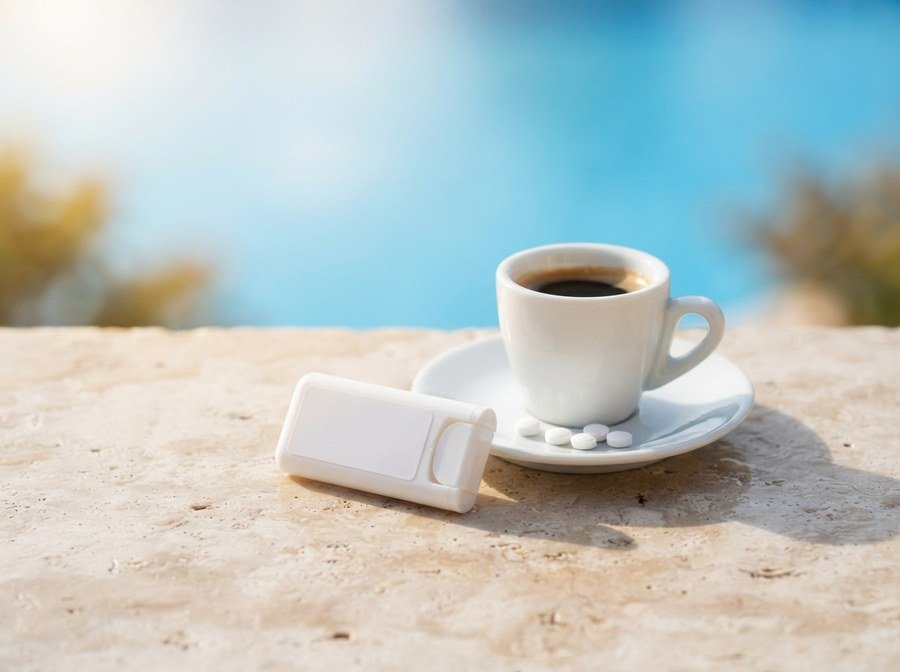
FIZZPHARMA makes effervescent tablets, drink cubes and sachets under other brands' labels, and takes briefs for table-top sweeteners, with the format confirmed in our reply. This article covers what the label law asks, what the 2026 sugar taxes touch, and what to decide before you brief a manufacturer.
Key takeaways
- The sales name is fixed by law: "[sweetener]-based table-top sweetener" (Regulation 1333/2008, Article 23).
- Your sweetener picks the warning: polyols bring a laxative line, aspartame a phenylalanine line.
- Saudi Arabia and the UAE moved to sugar-per-100-ml tiers on 1 January 2026, and artificially sweetened drinks sit at zero. The levy is written for drinks, not for the tablet on a counter.
- The tablet count per dispenser fixes the pack, so the dispenser is a pack decision as much as a tablet decision.
- Small packs leave little room: under 80 cm² the print height drops to 0.9 mm, and the name and warning must still fit.
What is a table-top sweetener under EU law, and what must the name say?
Regulation 1333/2008 treats sweeteners as food additives. A table-top sweetener is a preparation of permitted sweeteners, sold to the final consumer as a substitute for sugars. It may also contain other additives or food ingredients. A tablet in a dispenser is exactly that. The pack must carry:
| Label element | What the rule says | Applies when | Where |
|---|---|---|---|
| Sales name | "…-based table-top sweetener", naming the sweetener | Always | Reg. 1333/2008, Art. 23(2) |
| Polyol warning | "excessive consumption may induce laxative effects" | The tablet contains polyols | Art. 23(3) |
| Aspartame warning | "contains a source of phenylalanine" | Aspartame or aspartame-acesulfame salt | Art. 23(3) |
| Safe-use information | Manufacturer gives the buyer what is needed for safe use, by appropriate means | Always | Art. 23(4) |
| Print height | x-height at least 1.2 mm; 0.9 mm if the largest face is under 80 cm² | Always | Reg. 1169/2011, Art. 13(2)–(3) |
| Sugar claims | "Sugars-free" only at 0.5 g of sugars or less per 100 g | A claim is made | Reg. 1924/2006, Annex |
The cost of all this is space. A pocket dispenser has a small face, and the name, the warning and the brand have to share it.
What does your choice of sweetener decide for you?
The sweetener comes first because it picks the warning. A polyol-based tablet carries the laxative line. A tablet with aspartame carries the phenylalanine line. Which warning applies turns on the exact ingredient list, so confirm it ingredient by ingredient.
Mind one wording detail. The tablet rule says "induce". The general rule for foods with more than 10% added polyols (Regulation 1169/2011, Annex III, point 2.4) says "produce". Use the wording that matches the rule your product falls under.
How many countries tax sugary drinks, and what changed in 2026?
WHO reported on 13 January 2026 that at least 116 countries tax sugary drinks. Saudi Arabia and the UAE both moved to tiered rates on 1 January 2026: the tax follows grams of sugar per 100 ml of the ready drink, and drinks sweetened only with artificial sweeteners sit at zero.
| Market | Basis | Rate or tier | Powders and concentrates |
|---|---|---|---|
| Saudi Arabia, from 1 Jan 2026 | Sugar per 100 ml of ready drink | Zero below 5 g and for drinks with only artificial sweeteners; SAR 0.79 per litre at 5–7.99 g; SAR 1.09 per litre from 8 g | Counted as prepared, per pack instructions |
| UAE, from 1 Jan 2026 | Same tier structure | Artificially sweetened drinks at zero | Confirm with your importer |
| South Africa, since 2018 | Sugar above 4 g per 100 ml | 2.1 cents per gram | Counted on prepared volume |
| UK | 5 g per 100 ml, ready to drink or diluted | Banded levy | Powder sold as powder is excluded |
Saudi Arabia's tiers replaced a flat 50% of retail price. In the UAE, a 330 ml artificially sweetened cola fell from about Dh 2.50 to Dh 1.65–1.70, while cheap sugary drinks rose 20–40% (Gulf News, 7 January 2026).
Do sugar taxes apply to a sweetener tablet?
The published tiers are written for drinks: they count sugar per 100 ml of the ready drink and treat powders, concentrates and gels as prepared. For a sweetener tablet, ask your importer for its tax and customs classification in writing.
What does change is the context. Recipe sugar is now a line on the cost sheet: a drink that moves from 6 g to 8 g per 100 ml goes from SAR 0.79 to SAR 1.09 per litre in Saudi Arabia. That is a market signal. For a sweetener product, ask your importer how the levy treats it.
Why does the tablet count per dispenser matter?
The count fixes dispenser size, label area and shelf footprint before anyone talks about the tablet itself. A pocket dispenser and a counter dispenser need different labels, so settle the count before the artwork.
On the production side, the tablet press at the plant behind FIZZPHARMA is rated by its maker for effervescent tablets, mini-tablets, dispersible and matrix tablets, up to 25 mm in diameter and up to 396,000 tablets an hour.
What should you decide before you brief a sweetener tablet manufacturer?
Four decisions, in this order:
- Choose the sweetener. It sets the name and the warning, and the front of the pack follows from them.
- Choose the count and the dispenser. Check the label area against the 0.9 mm print rule before you commit to a pocket size.
- Ask your importer how the product is classified. The Gulf tiers are written for drinks, so get the tablet's tax and customs classification in writing.
- Brief the manufacturer with those answers. The sweetener, tablet size, dispenser and destination market are the four lines that get a useful reply the first time.
With FIZZPHARMA, the label artwork is prepared with you and approved before printing; the pack is confirmed in our reply.
FIZZPHARMA sends a certificate of analysis and a specification with every batch, so your importer can file the registration with those documents.
Send the four lines above. The reply comes within 24 hours, Monday to Friday, and states the terms for your programme.
Frequently asked questions
What must the label of a private label sweetener tablet say?
In the EU the sales name must include the term "[sweetener]-based table-top sweetener" under Article 23 of Regulation 1333/2008. Polyol tablets need a laxative warning, aspartame tablets a phenylalanine line, and the manufacturer provides safe-use information. FIZZPHARMA designs the label or works from the artwork you bring, and the artwork is approved before printing.
Does a sweetener tablet need a laxative warning?
Only when it contains polyols. Article 23(3) of Regulation 1333/2008 requires "excessive consumption may induce laxative effects" on table-top sweeteners with polyols. The rule turns on the ingredient list, not the product type, so send FIZZPHARMA the sweetener you have in mind before the label is drafted.
Is a sweetener tablet taxed under the Saudi or UAE sugar tax?
The 2026 tiers are written for drinks. They count grams of sugar per 100 ml of the ready drink and treat powders and concentrates as prepared. For a sweetener tablet, FIZZPHARMA advises asking your importer how the levy treats a sweetener product, and getting its tax and customs classification in writing before you print the pack.
Can I write "sugars-free" on a sweetener pack?
Only if the product holds no more than 0.5 g of sugars per 100 g (Regulation 1924/2006, Annex), and the wording must not mislead. FIZZPHARMA treats it as a condition your composition has to meet, not a selling line, and recommends that your importer checks the claim rules of the destination market.
Can I use my own packaging?
Your own packaging is possible with FIZZPHARMA on request: send its specification with the enquiry, and the answer comes in our reply. Settle the tablet count per dispenser first, because it sets the label area.
Which documents come with a batch?
FIZZPHARMA sends a certificate of analysis and a specification with each batch. Copies of the site certificates (ISO 22000, GMP, HACCP) go to clients on request. Your importer files any registration with these documents.
How quickly does FIZZPHARMA answer a sweetener enquiry?
Within 24 hours, Monday to Friday. Include the sweetener, the tablet size, the dispenser type and the destination market. The terms for a sample are given in our reply to your brief.
Sources
- WHO, "Cheaper drinks will see a rise in noncommunicable diseases and injuries", 13 January 2026: https://who.int/news/item/13-01-2026-cheaper-drinks-will-see-a-rise-in-noncommunicable-diseases-and-injuries (reviewed 2026-10-18)
- EUR-Lex, Regulation (EC) No 1333/2008, definition of table-top sweeteners and Article 23: https://eur-lex.europa.eu/legal-content/EN/TXT/HTML/?uri=CELEX:32008R1333 (reviewed 2026-10-18)
- EUR-Lex, Regulation (EU) No 1169/2011, Article 13 and Annex III point 2.4: https://eur-lex.europa.eu/legal-content/EN/TXT/HTML/?uri=CELEX:32011R1169 (reviewed 2026-10-18)
- EUR-Lex, Regulation (EC) No 1924/2006, Annex: https://eur-lex.europa.eu/legal-content/EN/TXT/HTML/?uri=CELEX:32006R1924 (reviewed 2026-10-18)
- EY Global Tax News, Saudi sweetened-beverage tiers, 3 December 2025: https://globaltaxnews.ey.com/news/2025-2415 (reviewed 2026-10-18)
- KPMG Saudi Arabia, excise tax amendments for sweetened beverages: https://kpmg.com/sa/en/insights/tax-insights/amendments-to-the-excise-tax-implementing-regulations-primarily-impact-sweetened-beverages.html (reviewed 2026-10-18)
- Gulf News, UAE sugar tax and drink prices, 7 January 2026: https://gulfnews.com/business/retail/uaes-new-sugar-tax-is-already-changing-what-residents-pay-for-drinks-1.500400390 (reviewed 2026-10-18)
- South African Revenue Service, Health Promotion Levy: https://www.sars.gov.za/customs-and-excise/excise/health-promotion-levy-on-sugary-beverages (updated 19 August 2026, reviewed 2026-10-18)
- GOV.UK, Soft Drinks Industry Levy liability: https://www.gov.uk/guidance/check-if-your-drink-is-liable-for-the-soft-drinks-industry-levy (reviewed 2026-10-18)